
Corsica (June 2025)

Updated: Oct 1, 2025
There are some places that make such an immediate and distinct impression on you that it becomes clear that you may not be able to stay away in future. Corsica had been somewhat of a dream destination for us for several years, and certainly did not disappoint, with a whole suite of new invertebrates to become acquainted with. There are numerous endemic species and sub-species as a result of many millions of years of separation, some of which are shared with neighbouring Sardinia, others throughout the Tyrrhenian region.
The island is sometimes known as ‘the mountain in the sea’; the mountains comprise the majority of the island, almost a spine down the middle, and much of the area is also forested with pine and some deciduous trees. The habitat is broadly divided between mountainous and Mediterranean scrub with evergreen Quercus, which fringes the coast almost the entire way around the perimeter.
For some reason, the mountains in Corsica had a wholly different feel to many other places (perhaps due to the difference in geology) and supplied the areas we visited with an abundance of intrigue and excitement when it came to the flora and fauna.

LOCATION: SUARTONE
In June, the island is baked in 30+ degree heat which makes bugging during the day quite difficult. Outside the mountains there is little shade, and the low-lying bushes of maquis scrub that fringe the coast provide little respite. This heat takes on a voice at this time of year, the relentless high tone of cicada song, which reverberates from each tree and seems to make the air itself twice as thick. The singers themselves, Cicada orni mostly, manage to produce this sound with apparently minimal effort, sitting demurely on their tree trunks and shimmying around to the other side if approached.

The swimming pool provided a much-needed source of water and coolness for more than just the holidaymakers. The pool was lit until about ten o’clock, after it got dark, but it officially shut at about eight. There was therefore a brief period of about half an hour where the pool was still lit but the sky was dark, which created some interesting encounters.
Every night from sundown the tree frogs (Hyla sarda) would appear – from where they materialised was anybody’s guess, since the landscape around seemed too barren and scorched to ever permit the survival of such delicate looking amphibians. Initially, I was worried about the frogs using the pool because of the chlorine – not that there was anything I could have done about it – but there actually appeared to be very little chlorine in this pool, possibly none at all.


Like clockwork, as it started to get dark the frogs would be there, stuck to the natural granite boulders incorporated into the pool’s design (which permitted very easy entry and exit for all forms of life) and leaping excitedly after the large numbers of insects which had come down to drink and become stuck. They would sit in the pool with their forequarters out and arms folded neatly, looking exactly as though they were relaxing in a jacuzzi, a bizarre reflection of the daytime holidaymakers using the facilities. Occasionally one of the males would produce a bashful little croak, and the others in response would produce a rapid-fire burst of song which would echo off the surface of the still pool from all angles, sounding like a cackling band of miniature hyenas. Nightjars purred and scops owls called in the distance, and on one occasion a nightjar came down to drink, hovering centimetres above the water for several seconds before noticing us and flying silently away over our heads. I tried waiting out on several more nights with the camera, but never saw him again. On another occasion, we discovered a large Green Toad (Bufotes viridis) sat on one of the boulders wearing a guilty-looking expression. In front of her was a large Rhinoceros Beetle (Oryctes nasicornis) which she'd clearly sized up for a decent meal before realising that the beetle was far too large and spiky to fit inside her mouth.


Fireflies (Lampyris lareynii) could also be seen occasionally. Never in large numbers, just the occasional flicker of green light in the darkness.
During the day, numerous butterflies flitted between the trees and shrubs, offering not much more than a flash of colour or a glimpse of markings. Nonetheless, by the end of our first day I had already seen several species, including the magnificent Two-tailed Pasha (Charaxes jasius), a powerful flier which never seemed to come down from up above the scrub and canopy.
In our small area near Suartone, there were some insects to be seen around the coast and between the scrub. These included the beautiful Eresus kollari, the females with their heads dusted in fiery gold; dainty-looking owlflies (Libelloides ictericus) skirted the fringes of the grasslands, while grasshoppers in an enormous variety of colours and textures burst in frantic sprays from beneath our feet.


Above: Libelloides ictericus, Oedipoda caerulescens, Syromastus rhombeus, Eresus kollari female

Protaetia morio – we started calling them ‘head scarabs’ after a while, as they seemed preoccupied with landing on and inspecting the very top of your head. This was probably some form of hill-topping behaviour rather than us looking or smelling like flowers…
LOCATION: BONIFACIO AND SOUTHERN BEACHES
Nowhere did we see more grasshoppers than at the Plage de Saint Antoine, a small bay on the very southern tip, close to (and with a view of) Bonifacio. Every step disturbed what appeared to be hundreds of them, of all sizes and in all possible pattern and colour combinations.

Above: Oedaleus decorus
We descended the slope to the small limestone beach overshadowed by the peculiar standalone cliff, with a coarse white gravelly-sandy substrate. Under some of the embedded rocks were some huge pseudoscorpions, alongside Shore Earwig (Labidura riparia). Running about over the sand were the rotund and always pleasing Pimelia, in this case P. payraudi, and lots of velvet ants (Dasylabris maura).


Above: shore earwig, Pimelia payraudi, stock (Matthiola sp.) and Dasylabris maura, Stenosis sp.(or at least Stenosini), Graphosoma semipunctatum. I have never seen so many G. semipunctatum in a week before, they were by far the most dominant shieldbug species all over the southern half of Corsica.

Above: enormous pseudoscorpions
Here and there trundled the peculiar armoured tenebrionid Akis bacarozzo, a native of several Mediterranean islands including Corsica, Sardinia, the Balearics and Sicily, alongside parts of mainland France and Italy. They really are like little armoured tanks, and functioned as unfussy cleaners of waste in a landscape that otherwise looked barren to the eye. They grouped and bustled around such nutritious items as dog poo which had been left out.


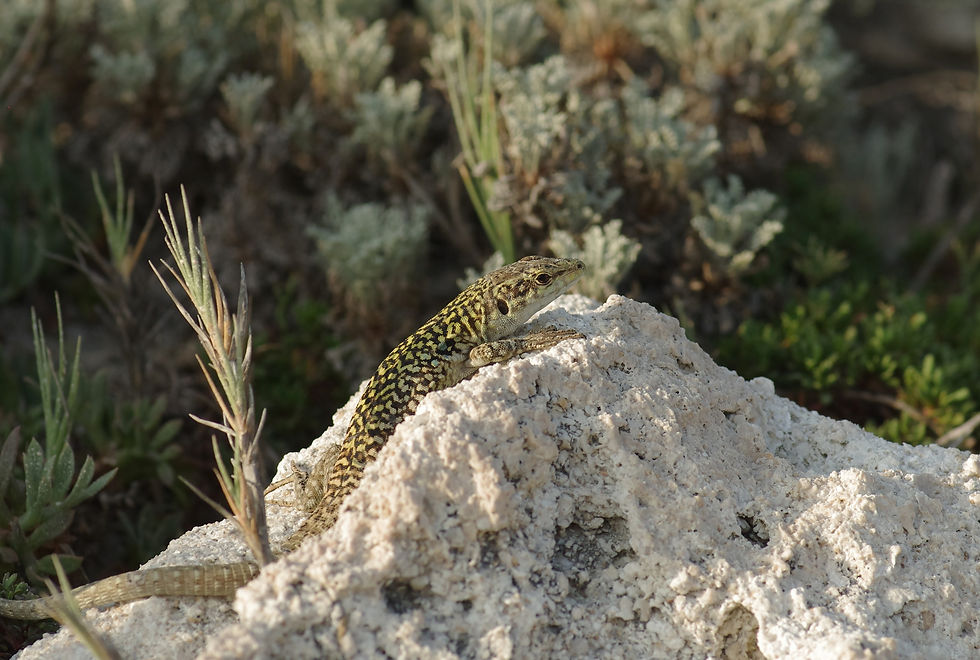
Here I also saw some beautiful Tyrrhenian Wall Lizards (Podarcis tiliguerta) basking on the rocks as it got cooler in the evening.
Bonifacio itself is an interesting port town set on a large projecting cliff, with the old town wrapping around and through a citadel, featuring narrow back alleys and armoured gates. I don’t typically venture much into cities while being a tourist abroad, but Bonifacio was a truly fascinating place, with many of the houses built flush to the cliff, bits almost hanging over the edge. Some of the shops we looked in had windows that looked out to sea, and by looking out of these you could make out the height of the house on the cliff above the surface of the water. Because the houses are tall and rather narrow, many flats and parts of buildings are accessible through high and very intriguing-looking narrow staircases, sloping up into the darkness.


In many of the shops on Corsica can be found jewellery made of coral, orange-red and often in very small pendants. According to various sources (here, here and here) the collection of coral, Corallium rubrum, in Corsica is heavily regulated, with only seven fishermen allowed to harvest it, and limited still in how much they are allowed to take per year. The coral is found between 50-120 metres, quite an intensive dive for coral collectors, and only very tiny outer branches are tapped in order to prevent significantly damaging the animal or preventing the corals from being able to reproduce. The jewellery fashioned from these small pieces is commonly formed into curious small hands and lucky horns, sometimes phalluses, all symbols to ward off the evil eye. The hand symbols represented are the ‘manu figa’ or ‘fig hand’, (made by balling the hand into a fist and putting the thumb between the fore and middle fingers, as in the lighthearted ‘got your nose!’ in the UK, where these gestures are not interpreted as rude) and the ‘manu cornuta’ ‘sign of the horns’, with the fore and pinky fingers extended and the two middle fingers down. Both of these signs are mildly obscene sexual gestures in some places, equivalent to giving somebody the middle finger, but in this instance used as an apotropaic gesture to ward off the evil eye, or put off evil spirits, who are presumably distracted by the obscenity of the gesture and thus miss the opportunity to make mischief with you.
I saw a few insects in downtown Bonifacio, including Eurydema ornata and the anthracite fly Exoprosopa jacchus.


Above: Exoprosopa jacchus and Eurydema ornata
One small coastal site we visited near Gurgazu proved to be a butterfly haven. I have never seen so many ‘browns’ all together before, all feeding on sea rocket growing on the shoreline. Common Blue (Polyommatus icarus), Brown Argus (Aricia agestis), Meadow Brown (Maniola jurtina), Southern Gatekeeper (Pyronia cecilia) and Corsican Wall Brown (Lasiommata paramegaera) were all common, a feast for the eyes alongside numerous beautiful bees, scoliid wasps (Scolia hirta) and more Eurydema. Occasionally a Pea Blue (Lampides boeticus) flitted past, while under the trees further back the huge and spectacular Great Banded Grayling (Brintesia circe) danced between the conifer branches. The cherry on top was undoubtedly a fantastic Corsican Heath (Coenonympha corinna) who was certainly not camera-shy.


Above: Southern Gatekeeper, Corsican Wall Brown, Pea Blue, Common Blue, Brown Argus

Above: Great Banded Grayling

Above: Corsican Heath
Under a rock we found the only scorpion of the trip, fresh and shiny from a moult, Euscorpius flavicaudis or sicanus. Also underneath the wooded areas were the hornet-mimicking hoverfly Volucella zonaria, in a slightly darker form which is apparently peculiar to Corsica.

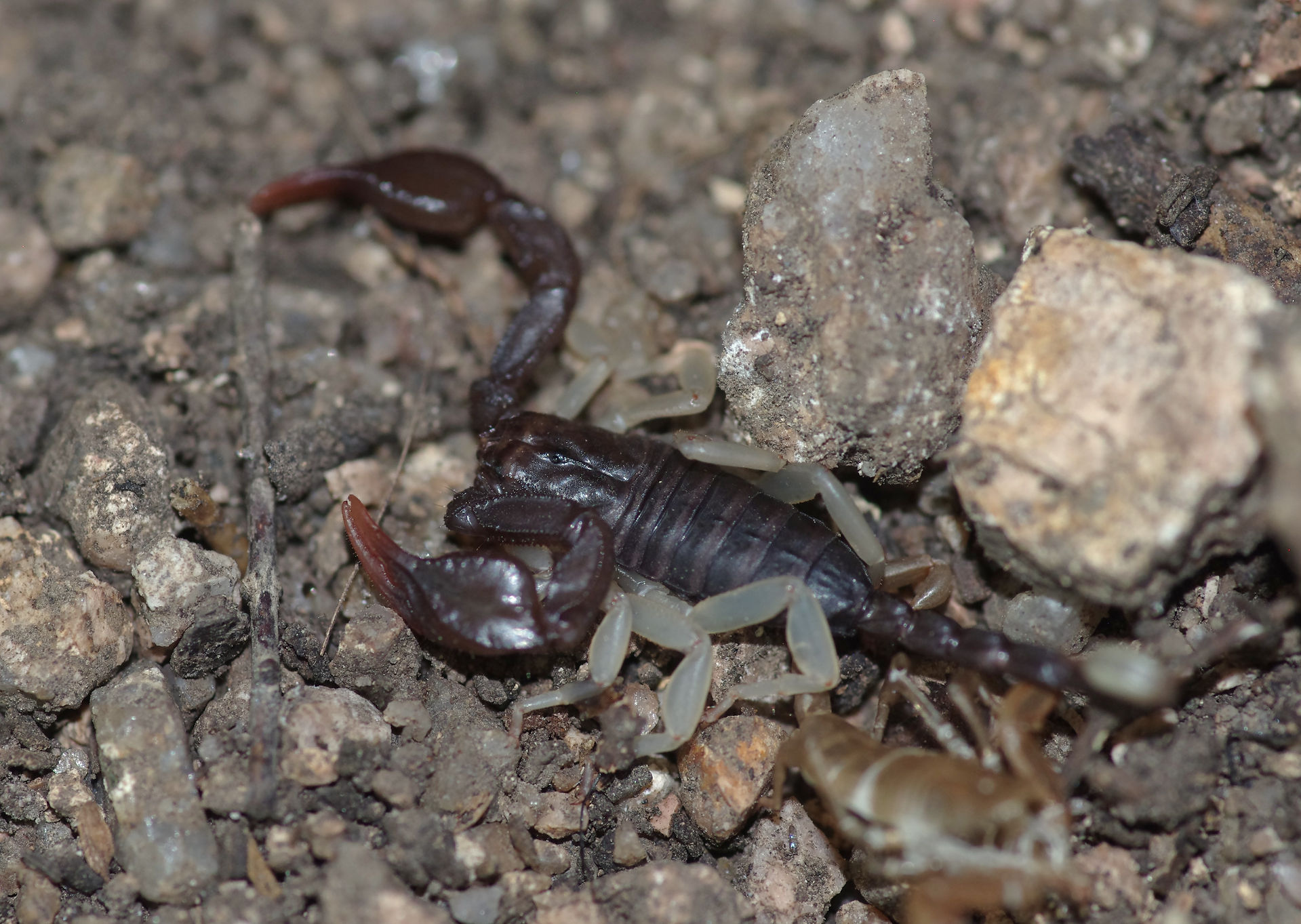


Above: Volucella zonaria, Euscorpius, Eurydema ornata
LOCATION: PORTO-VECCHIO
We made a few quick and largely unproductive stops at beaches near Porto-Vecchio, which were too dry for woodlice and had been built on since many of the original papers came out, rendering exact locations largely inaccessible for us. The locations made for a few artsy photos but not a lot else.


Above: Peacock Blenny (Salaria pavo) and Saint Piran's Hermit Crab (Clibanarius erythropus)
To reach one or two locations we had to walk down stretches of very straight roads and it was rather interesting, although ultimately quite saddening, to see the insect fauna which had been unsuccessful in its journey. Many dead insects littered the sides of the road, including such conspicuous species as Akis bacarozzo, Megascolia maculata, Cetonia aurata, Sisyphus schaefferi and Pimelia payraudi. Happily, one of the insects I picked up transpired to still be alive; Capnodis tenebrionis, an enormous wood-borer largely abhorred as a pest of fruit trees, although I was quite excited to see it as it was a truly fantastic creature up close.


Above: two live buprestids, Capnodis and Anthaxia hungarica


At one location I also found a female Empusa pennata – notoriously difficult to photograph (for me, anyway!)


Shieldbugs were a bit thin on the ground, but I was pleased to find the cryptic Psacasta tuberculata on Echium vulgare after only ten minutes of dedicated searching.


Above: two species of Sciocoris, S. sideritidis on the left (distinguished by its pale shoulder pads) and S. helferii on the right.

And a very cooperative Southern White Admiral (Limenitis reducta)!
LOCATION: SOUTHERN PEAKS (TOWARDS ZONZA)
When we discovered that a road-trip through the mountains in the evening was not only possible but extremely fun, we were unable to stay away. Every evening and night had us driving the wide, winding mountain pass roads for hours, and we must have ended up doing most of the roads between Porto-Vecchio and Zonza, stopping en route.
On several occasions we found the beautiful little brown Tyrrhenian Painted Frogs (Discoglossus sardus), found in the Tyrrhenian archipelago and parts of coastal France and Italy.


In many of the damp valleys underneath bridges and by rivers could also be found the beautiful and large Helleria brevicornis, an emblematic invertebrate of Corsica, where its primary stronghold lies.

I became reacquainted with a shieldbug from 2024, this time as an adult: Dryadocoris apicalis, a solanum feeding bug which is somewhat uncommon. Certainly it didn’t appear typical to find this species in the mountains, but since it’s quite brown and well camouflaged, the fact that it is under-recorded is probably not too surprising.


Dryadocoris apicalis, and a bonus beautiful Stictoleptura cordigera
We stopped in front of an abandoned villa on the outskirts of a small village. The small wooden gate was padlocked, long since rusted, and the paint on the shutters was gently peeling, behind which the faded windows could be seen. A small movement caught my eye, and to my delight a small group of tiny bats could be seen squeezing in and out under the top crack of a ground floor shutter, wiggling to get through the gap. A beautiful and peaceful home for the bats, as well as people at some point.

The shutter in question… minus the bats here unfortunately, I suspect they were waiting for us to leave before continuing business as usual.
We saw a bit of mammalian life during these evening drives, with the most obvious of the island’s mammals being the Wild Boar (Sus scrofa). The Sangliers were often just standing at the side of the road, feeding, or walking casually following the verges, as though they were very road-savvy and knew where was the safest place to cross. We only saw two car victims during our trip, so the combination of fairly low traffic and road safety-aware boars was obviously an effective one. On one occasion, two females passed under a fence and walked right in front of us, only several metres away, which would have made for a fantastic photo had I not forgotten to alter the camera settings in my excitement.

We also saw a couple of foxes; a dark-ish adult crossing a beachside car park after the majority of the visitors had gone, and a very young one who wandered out into the road, was momentarily shocked by the headlights (and was very lucky I was able to smoothly slow and stop the car for him) and then turned and returned (presumably to his mother for a telling-off) back the way he came into the scrub.
On one of these drives we passed the Lac de l’Ospedale, a man-made reservoir built to provide water to lower villages. Despite being artificial, with a dam at one end, the lake is surrounded by rather more real forests and granite rock formations, and the drive to get there winds through spectacular landscapes, with a foreground of pine forests among rounded granite formations, a complex of live trees and dead trunks. This effect was of a prehistoric landscape, somewhat inaccessible, half anticipating to see something new around every corner. Corsica is one of Europe’s great wildernesses, and it can be felt all over the middle portion of the island as soon as you leave the coastal road. The rugged red peaks with their blankets of pine trees seem to go on and on, and I became very aware of the fact that, despite the awe-inspiring scenery, this was only the southern end – these weren’t even considered the high mountains.


Above: Lac de l’Ospedale
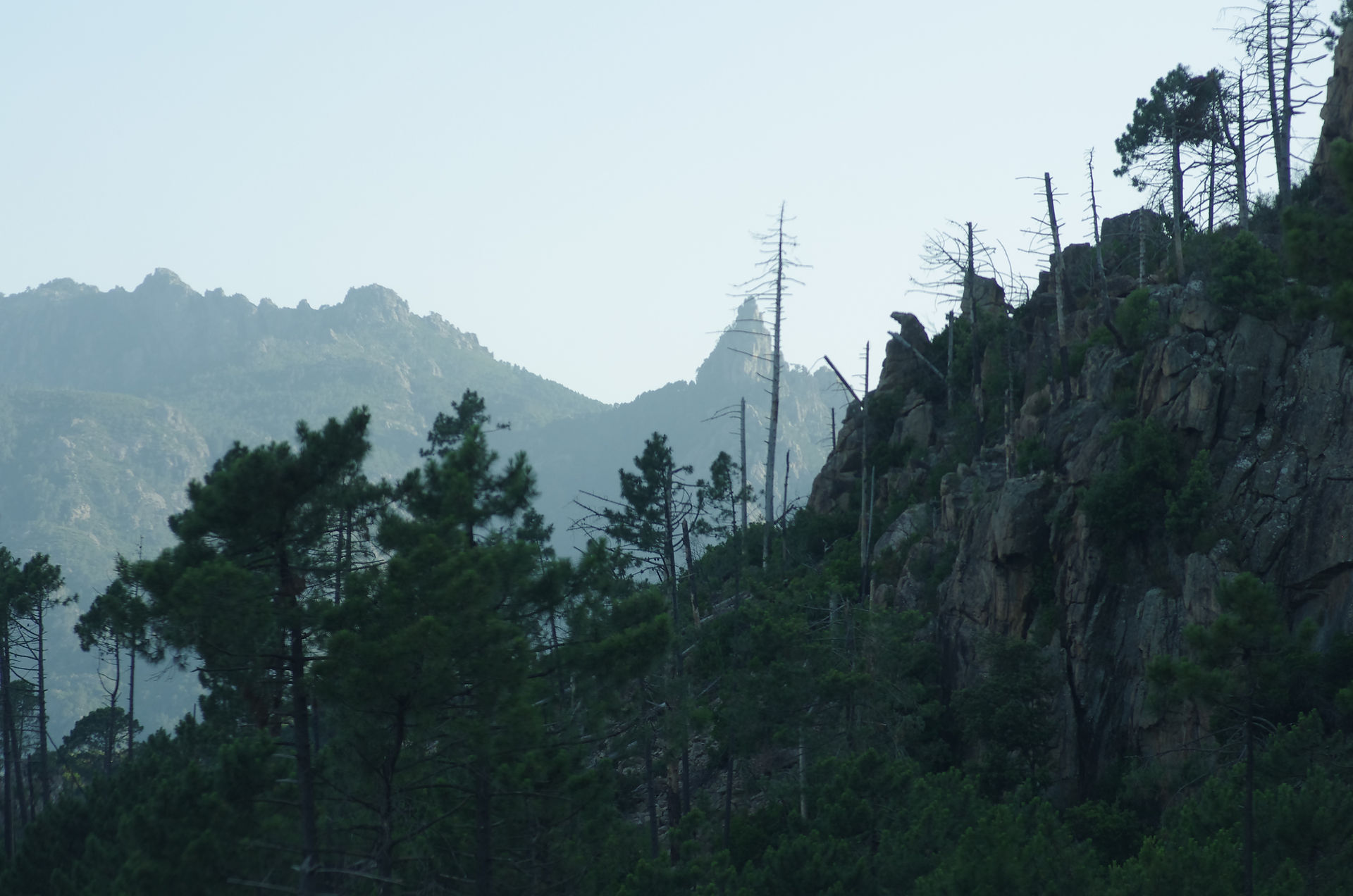


There was something rather special about Corsica. Here, there was the almost painful awareness that we had really barely scratched the surface of the invertebrate fauna, not to mention didn’t approach the northern part of the island, with slightly different geology and environments. The glimpses we got at this rather warm time of year were more than enough to whet the appetite for further entomological excursions in the future.
SHIELDBUGS
• Aelia acuminata
• Ancyrosoma leucogrammes
• Carpocoris mediterraneus
• Cyphostethus tristriatus (Juniper Shieldbug)
• Dryadocoris apicalis
• Eurydema ornata
• Eurydema ventralis
• Graphosoma semipunctatum
• Piezodorus lituratus (Gorse shieldbug)
• Psacasta tuberculata
• Sciocoris cursitans
• Sciocoris sideritidis
BUTTERFLIES
• Aricia agestis (Brown Argus / Collier-de-corail)
• Argynnis pandora (Cardinal)
• Brintesia circe (Great Banded Grayling / Silène)
• Cacyreus marshalli (Geranium Bronze / Brun du pélargonium)
• Celastrina argiolus (Holly Blue / Azuré des Nerpruns)
• Charaxes jasius (Two-tailed Pasha / Nymphale de l'Arbousier)
• Coenonympha corinna (Corsican Heath / Fadet tyrrhénien)
• Colias croceus (Clouded Yellow / Souci)
• Gonepteryx cleopatra (Cleopatra / Citron de Provence)
• Lampides boeticus (Pea Blue / Azuré porte-queue)
• Lasiommata paramegaera (Corsican Wall Brown / Mégère corse)
• Leptidea sinapis (Wood White / Piéride du Lotier)
• Limenitis reducta (Southern White Admiral / Sylvain azuré)
• Lycaena phlaeas (Small Copper / Cuivré commun)
• Maniola jurtina (Meadow Brown / Myrtil)
• Papilio machaon (Swallowtail / Machaon)
• Pararge aegeria (Speckled Wood / Tircis)
• Polyommatus icarus (Common Blue / Azuré de la Bugrane)
• Pyronia cecilia (Southern Gatekeeper / Ocellé de le Canche)
• Vanessa cardui (Painted Lady / Vanesse des chardons)
• Vanessa atalanta (Red Admiral / Vulcain)
INVERTEBRATE HIGHLIGHTS
• Akis bacarozzo (Akis ponctué)
• Capnodis tenebrionis (Capnode du Pêcher)
• Cicada orni
• Empusa pennata (Cone-headed mantis / Diablotin)
• Eresus kollari
• Helleria brevicornis
• Libelloides ictericus
• Oryctes nasicornis
REPTILES AND AMPHIBIANS
• Bufotes viridis (Green Toad / Crapaud vert)
• Discoglossus sardus (Tyrrhenian Painted Frog / Discoglosse sarde)
• Hyla sarda (Sardinian Tree Frog / Rainette sarde)
• Natrix helvitica corsa (Grass Snake / Couleuvre helvétique corse)
• Podarcis tiliguerta (Tyrrhenian Wall Lizard / Lézard tyrrhénien)
• Tarentola mauitanica (Moorish Gecko / Tarente de Maurétanie)


