
Southern Spain (April 2026)

South Spain is an entomologist’s paradise. It’s also a treasure trove of reptiles, amphibians, mammals, birds, fish, molluscs, plants, geology, history and culture, so no amount of time is truly enough to achieve anything remotely resembling satisfaction that you’ve seen very much at all.
Why is southern Spain so biodiverse?
The Iberian Peninsula (including Spain and Portugal) was a glacial refugia during the last Ice Age, which is a large oversimplification of the complex climatic, genetic and biogeographic processes that were occurring in the area. Over the last few hundred thousand years, and certainly in the last 50,000, the ice sheets which are currently limited to the arctic circle extended much further down in latitude (advancing and retreating between glacial and interglacial periods), covering northern Europe entirely and forcing many species further south. The southernmost point that many of these species ended up at was the geographic area which would later become known to us as Spain and Portugal, where the ice never quite reached, and here they were able to spread, adapt, and differentiate. A combination approach of diverse habitats (the several mountain ranges offered even more diverse microhabitats) and climates (everything from mountain to semi-desert) led to the formation of numerous endemic species and sub-species, found nowhere else. Even though the last glacial maximum was approximately 20,000 years ago and the climate has been more or less steadily warmer ever since, many species have become well-adapted to this area and did not all spread northwards again. Some of those that did include the familiar Roe Deer (Capreolus capreolus), Wood Mouse (Apodemus sylvaticus) and Natterjack Toad (Epidalea calamita). The result today is an area with a huge number and diversity of species, from plants all the way to vertebrates.
This was a family holiday and as always, a delicate balance needs to be maintained between bugging from dawn until dusk every single day until you drop and trying to ensure everybody has what they can go home and describe as a ‘pleasant holiday’. Generally I think we are fairly good at achieving this, and I was personally happy enough on this excursion to have seen some wonderful species, including familiar faces and new acquaintances.

Coast: Almuñécar to Maro
The coast of the general area we were staying in consisted of patches of scrub between towns and harbours. These were very productive, cool in the evenings and warming up very fast as the sun started to peek over the crest of the hills. The plant life generally consisted of coarse grasses interspersed with lots of Echium, Lavandula, numerous vetches, Pallenis maritima (commonly called ‘Gold Coin’) and, closer to the sea, ungainly-looking Sea Squill (Drimia maritima) and forests of pine and fan palm (Chamaerops humilis). On several occasions we saw the beautiful Pink Butterfly-orchid Anacamptis papilionacea, so bright they seemed to be radiating light from the dappled glades under the pine trees, and more subtly between shrubs could be seen the Yellow Bee-orchid Ophrys lutea and Mirror Orchid Ophrys speculum.


Above: Pallenis maritima, Ophrys speculum, Anacamptis papilionacea, Ophrys lutea
Common nearly everywhere we visited, but especially in these scrubby coastal areas, were Spanish Festoons (Zerynthis rumina), fantastic, energetic harlequin-patterned butterflies clad in cream, red and black. There seemed to be different generations of adults and larger caterpillars about, feeding on the pipevine Aristolochia baetica. The caterpillars were well-dressed too, red and chestnut with little spiky jesters’ hats. There was no need for them to hide away; feeding on pipevine renders them highly toxic.


Shieldbugs were in low numbers but a few exciting species. After the usual Cydnus aterrimus (feeding at the base of the numerous Euphorbia), Carpocoris mediterraneus and large numbers of Hairy Shieldbugs Dolycoris baccarum, there came one single Brachynema germarii and Canthophorus melanopterus, both new species for me.


Above: Brachynema germarii, Cydnus aterrimus, Dolycoris baccarum


Above: Canthophorus melanopterus

An unusual-looking but quite common harvestman, Metaphalangium cirtanum.


Pimelia sp., a near-universal inhabitant of coastal areas in southern Europe.


The lovely tenebrionid Sepidium bidentatum.

Armadillidium granulatum, a common species under rocks and wandering into the roads at night.

Tentyria sp. feeding on leftover ice cream

Swallowtail (Papilio machaon)
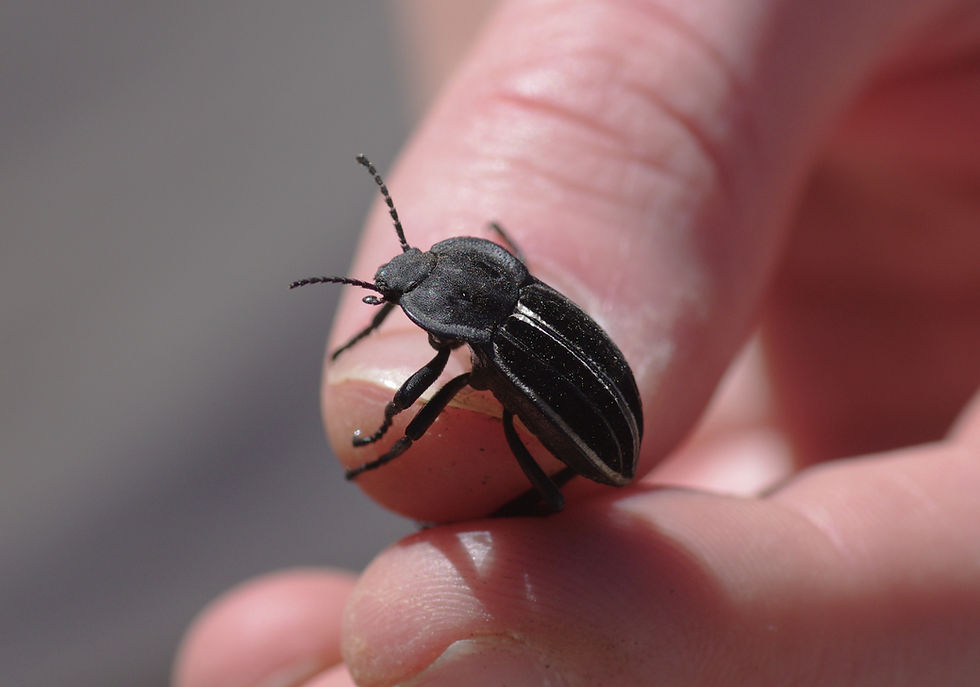
Alphasidia sp.


A webspinner, order embioptera; this female was wandering on the hot road, so she was moved into some shadier plants.
In the lightly forested areas near the sea on several parts of this stretch of coast, we finally discovered something which I had been hoping to see for years. The cliffs can be quite steep in places, which means that roads and paths are often cut into the sides, leaving exposed and moss-covered banks. This is the habitat of the extraordinary trapdoor spiders, family Nemesiidae. Their doorways are incredibly difficult to see at first, and usually a stroke of luck allows you to see one door and get your eye accustomed. The doors are perfectly positioned over the entrance to a very elaborate burrow, cut into what seems to be solid rock in places. The outside is virtually indistinguishable from the surrounding rock and moss, with only a hair-thin join visible externally. A small twig or piece of grass soon tells you if anyone is home – usually the occupant is clinging onto the door from inside, so it won’t budge, but occasionally they’ve gone out or retreated deep into the depths and the door can be sprung, from a perfect hinge at the top. Inside is an astounding piece of engineering: a tunnel, burnished to a perfect smoothness and comfort by some action of the spider (their chelicerae? Special hairs?) and going back an indeterminate distance. The tunnels varied from the size of a small fingernail to about a 2€ coin – presumably, the spider lives in one burrow for most of its life and just enlarges it when necessary. Sometimes, the remains of empty or abandoned tunnels had lost their doors and had been repurposed by bees or other spiders. The spiders themselves are difficult to trick, though this is unsurprising for something that relies on specific vibration patterns over the door and not the simple tugging of a thread. We tried hard to see one, but only on one occasion was an individual bold (or hungry) enough to try her luck with our piece of grass. To our surprise, what came out of the burrow was not a black or brown spider as we had been expecting, but a pale yellowish one. This seems to be something resembling genus Iberesia. There are numerous trapdoor spider species in the Iberian Peninsula, including multiple endemics and new discoveries. They were amazing, and it was fantastic to be able to see so many burrows.


Trapdoor spider burrows and occupant, plus habitat


In one of the areas we encountered the trapdoor spiders, my parents also found a fascinating set of plants, commonly known as ‘vampire cups’ – parasites that cannot produce their own chlorophyll. This species was Cytinus ruber, which parasitises rockroses (Cistus).

We also saw a nice Berberomeloe, B. insignis, digging her nesting hole by the side of the path.

The strange lygaeid Orsillus depressus
After at least two years of searching for this elusive shieldbug, we found some only a few hundred metres from where we were staying next to some public bins: Psacasta exanthematica!

These large and actually quite conspicuous species is blackish-brown and quite textured, with small pinpricks of off-white which perfectly match the dead or dried leaves of their foodplant, borages and buglosses (Boraginaceae) such as Echium, on which we found ours. The most commonly-recorded Echium in the area is E. sabulicola, a coastal species. This was a new shieldbug for me and felt well-earned, we all found our own individuals sitting at the very tops of plants and looking very obvious, though I suspect that they become much more difficult to spot when the plants aren’t lush with new growth.


I also found the smaller Psacasta tuberculata (below) on a few occasions.


On one plant I found both species, which allowed for a great comparison of size.

Flies were abundant at this time of year, with some lovely species out and about (plus some with admittedly not-so-lovely habits…). I found Urophora sp. on several occasions, a tephritid fly with beautiful striped wings, which makes galls in thistles. Next was a Ulidia sp. (Ulidiidae) a fairly inconspicuous-looking fly with big moves; I saw several on cat droppings, all of which were undertaking quite elaborate marches up and down, waving their wings about. Finally, a nice tachinid, Cylindromyia brassicaria, posing on a grass stalk on a cool evening.


Above: Cylindromyia, Ulidia, Urophora.
Gorge
At dusk one evening, we decided to spend the evening poking around at a nearby gorge. We weren’t alone as we pulled up; in addition to several families and campervans, there were a surprising number of people climbing or doing via ferratas, sometimes dizzyingly high on the cliffs – it looked like great fun. Almost from the moment of disembarking, I knew that this was a special site, as the bugs were turning up. The small sliver of grass and low herbs between the road and the base of the cliff was alive with bugs and beetles.

On a fallen sign in the car park was a Boat Bug (Enoplops scapha); we were sadly a bit too far east for its cousin E. bos, which has longer facial horns, but it was nice to see apparently quite extensive populations here, as it’s a rarity in the UK.


There were large numbers of Eurygaster austriaca here as well, including a rather exceptionally big and battle-scarred first individual. They also came in pink, high-contrast, and plain brown, all with the characteristic ‘pinched’ face and ridge along the back.


Simply beautiful Spanish Snapdragons Antirrhinum hispanicum, the longhorn Agapanthia annularis, Rhodalsine geniculata and a pretty little forest cockroach (Loboptera sp.)

House gecko Hemidactylus turcicus
We dropped down onto the riverbank, sandy and cool. From the cave-riddled rock face on the opposite bank a scops owl called hopefully despite the daylight, a soul-soothing noise; without the traffic noises it was absolutely still, with just the rushing of the water and the call of distant kestrels, screaming at the climbers who were getting a little close to their nest.

An incautious movement in the grass revealed a lovely grasshopper, a juvenile Truxalis nasuta, who was so well-camouflaged and phasmid-like that we wouldn’t have seen it at all if it didn’t move.
Nerja Cave and trails
One of Spain’s major tourist attractions and a cave with Palaeolithic art, Nerja was not a place we could miss. The accessible part of the cave is huge, dropping deep into the earth and extending back several hundred metres. The caves as a whole extend for over 5 kilometres (3 miles), but only limited halls are open to the public, with concrete walkways and barriers. The rock forms and features are incredible; in addition to the impressive stalactites and stalagmites there were pools and areas worn down by water, formations that looked like undersea corals, and everywhere small tunnels and chambers leading off into the inaccessible parts of the caverns.

The caves have been inhabited either temporarily or permanently for various periods over time, from between the Upper Palaeolithic (25,000 BC) until the Bronze Age (1800-600 BC), and were visited by people as far back as 41,000 years ago. Upper Palaeolithic cave paintings of various animals (including deer, horses, goats, seals, fish, according to the website) as well as possible figures and symbols, are located in the inaccessible galleries. There is also artwork from the Neolithic and Copper ages. Various species of invertebrate are known from the cave, including the small cricket Petaloptila malacitana and the beetle Platyderus spelaeus, and some Nerja endemics: the isopod Porcellio narixae, pseudoscorpion Ephippiochthonius nerjaensis and dipluran Plusiocampa baetica. We had no real opportunities to search for these species, but it was nice to know they were there somewhere.
The setup is quite good, and reflects how many international tourists visit the area; you buy tickets online, then download an app which contains guided notes for the cave and museum (the latter we didn’t end up visiting, which was a shame) in different languages. When you’re in the cave, signs on the floor indicate which soundbite to listen to, and you can do it in your own time. It says a lot about the cave’s size that you can easily spend an hour inside, and we did spend at least that trying to look for remnants of cave art, the majority of which is off-display for obvious conservation reasons. However, we did find some smudges of red ochre on some of the stalactites, possibly a hint of a shape just out of sight of the lights. It was surprisingly warm inside (perhaps because of all the people), not quite as warm as outside but with no breeze, which made it slightly stifling.


My only suggestion for improvement would be to address the timing of some of the soundbites. The audio for step 3 (I believe) states that you have just walked past some rock art, so we had to turn back and walk down the stairs again to look for it. The other was about the ecology of the cave, which came right at the very end – it says we had a chance to see some of the little crickets at the edges of the path as we walked around. Had I known this at the start I would have looked harder for some of the cave’s current residents, but I presumed (pre-emptively) that they almost exclusively lived out of the way of the lights. Perhaps I should have played all the audio beforehand then replayed it in order in the cave.

Above: phototrophic organisms forming a green film over rocks illuminated by the lights.
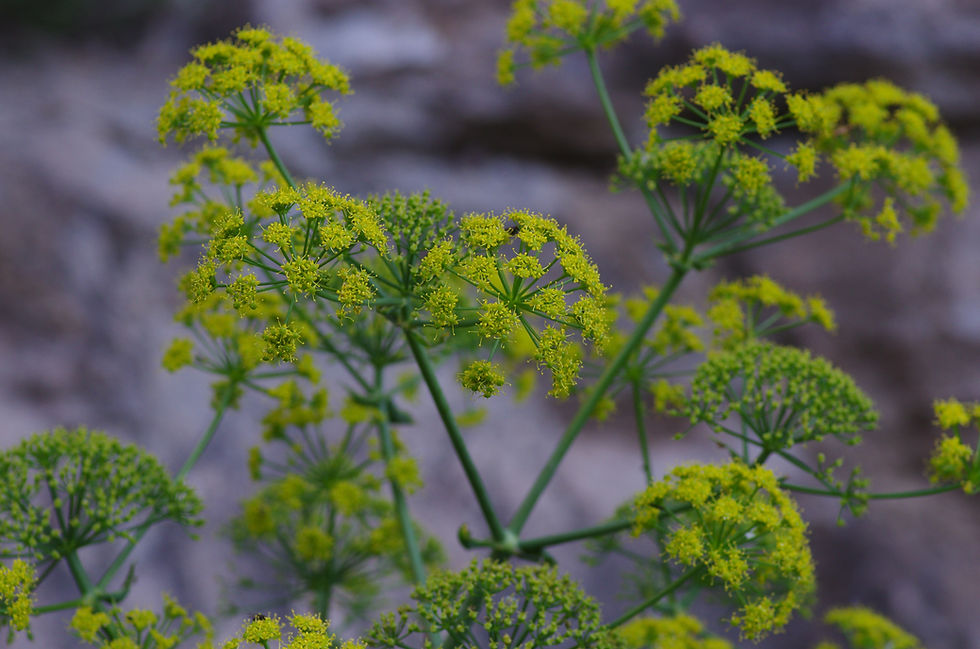
We then wandered for a way up the trail that leads from the parking area outside the cave park. It’s a nice easy road that winds around the hills, although it is often used by cars so you can never get your guard totally down, or lay down in the road to photograph anything. The landscape was dry and rocky, with lots of flowering and clump-forming plants, interspersed with stands of tall, impressive Giant Fennel (Ferula communis). The leaves of this good-looking umbellifer don’t smell an awful lot like normal fennel – perhaps just not at this time of year – but the flowers have a strong, musky, and somewhat unpleasant scent that attracts hordes of flying insects, mostly gnats and small bees.
The prize of this location came in the form of a fly I’d been hoping to see; the beautiful Rhyncomya columbina. Having seen its cousin R. peusi on a trip last year, and having read about the fascinating larval history of its African cousins, I was keen to see a few more of them. They look almost like a muscid or a greenbottle, but with stunning, glittering sapphire blue and turquoise eyes. They are instead in Rhiniidae, related to the Locust Blowfly Stormorhina lunata. This one was totally absorbed in her meal, licking nectar or pollen from Helichrysum flowers, which was apparently so delicious that even after being disturbed by us once or twice she kept returning, even pausing briefly on my trousers before resuming her lunch.


Rhyncomya columbina and Helichrysum sp.

Rhyncomya columbina and her beautiful blue sparkling eyes

Scutigera coleoptera


Asphodelus sp. and Ophrys fusca


Cistus clusii and Spotted Rock-Rose (Tuberaria guttata)

The small soldier beetle Malthinus sp.
Towards Almeria
This was a special trip for a specific purpose. In the mountains around Almeria can be found a fantastic insect, small and sometimes tricky to locate, but whose incredible appearance makes all effort expended in its honour worthwhile.
To get to the environment, you have to drive through El Ejido; a collection of plastic-covered greenhouses so large it can be seen from space. The area is known as the ‘garden of Europe’ (La Huerta de Europa) or the sea of plastic (El Mar de Plastico). The enormity of the greenhouses is difficult to convey – they go on forever, up into the hills, and when you turn off the main road and start weaving between them it is strange and still, any movement of workers within the growing areas masked by translucent plastic. Shadows of plants within we could identify tentatively as beans and tomatoes, but the interiors were a mystery and it seemed almost deserted from the outside.

Outside this area are hills and precipices, covered in Aleppo pine and grasses, with friable orangish soil. Dotted around the rocks are small, jagged caves and holes of indeterminable depth. The roads become gravel tracks, and it swiftly becomes very, very quiet.

Despite their small sizes, inside these caves and slot holes the temperature is several degrees cooler than the outside, though still dry, and the walls and ceilings seem precarious and held together by crumbling sand. With my head inside one of these little caves, I watched and waited for a glimpse of an amazing and strange creature, one of the more fascinating and mysterious inhabitants of the area. While very small and difficult to see at first, once your eye became adjusted they could be picked out with ease when they moved, despite their effective camouflage.
The creature in question is Necrophylus arenarius, a small neuropteran in the family Nemopteridae. As an adult they look a bit like small brownish craneflies, rather spindly and delicate, but as larvae they have one of the most unusual appearances of possibly any insect in Europe.
The larva has all the parts that would be expected of a neuropteran larva – the antlion-like head with scythe-shaped jaws, a rather squat body and stiff legs. However, in Necrophylus these are all elongate, on stilts; the legs are long and extend out from the sides of the body, which is small and square-ish, while the head sits atop a hugely extended prothorax, at least the length of the body. The function of this long neck is not fully known, though it probably has something to do with its feeding ecology. Necrophylus is allegedly so named because it was first discovered inside tombs in Egypt; despite the name, N. arenarius has no greater or lesser association with death than any other neuropteran, other than a choice of cave-like habitats that happened to occasionally be used as tombs by us humans, although it does give it a memorable name.


We finished the day with a stop at the very tip of the ‘peninsula’ comprised of nature reserves (Punta Entinas-Sabinar) and dune systems (trying to see chameleons). We got a bit more than we bargained for with the mosquitos, who were out in force and had apparently been starving themselves for days waiting for this moment; we didn’t spend as long here as I anticipated, but to voluntarily stay longer would have been nothing short of masochistic.


I did manage to see the unusual plant Cynomorium coccineum (above), a holoparasite of salt-tolerant plants such as Cistus. It's a peculiar-looking thing, larger than expected and deep red in colour, with a nice texture. It is sometimes called Red Thumb, and (erroneously) Maltese fungus or similar, this name allegedly coined by the Knights Hospitaller in Malta, leading to the naming of Il-Ġebla tal-Ġeneral (Fungus Rock) on the island. Elsewhere, it has or had other purported medicinal or edible properties, and was a famine food in some areas.

In addition, I saw a larva of Lasiocampa serrula as well as some faraway birds including flamingos (Phoenicopterus roseus).

Back at our accommodation, I found a Red Palm Weevil (Rhynchophorus ferrugineus). Although an invasive species and damaging to palm crops, they really are spectacular and very large beetles up close, with lovely-looking faces. This one had obviously been living its life to the fullest with a rather scratched up pronotum.

Reservoir La Viñuela
We visited this reservoir as a sort of gateway to the mountains – a beautiful and colourful landscape populated by great wildlife, and the weather was perfect; still and warm. Red-rumped swallows were flying down and collecting mud, while overhead a group of herons flew over, possibly squacco herons. Several older couples picked meticulously through the cool undergrowth underneath the trees searching for asparagus, adding each stalk to ever-increasing bundles of thin, weedy-looking stems. Blackbirds warbled in the background, and the only human noise other than ourselves and the asparagus-pickers were distant and muffled shouts of people on the water, practicing rowing.


Convolvulus tricolor and Gladiolus sp.
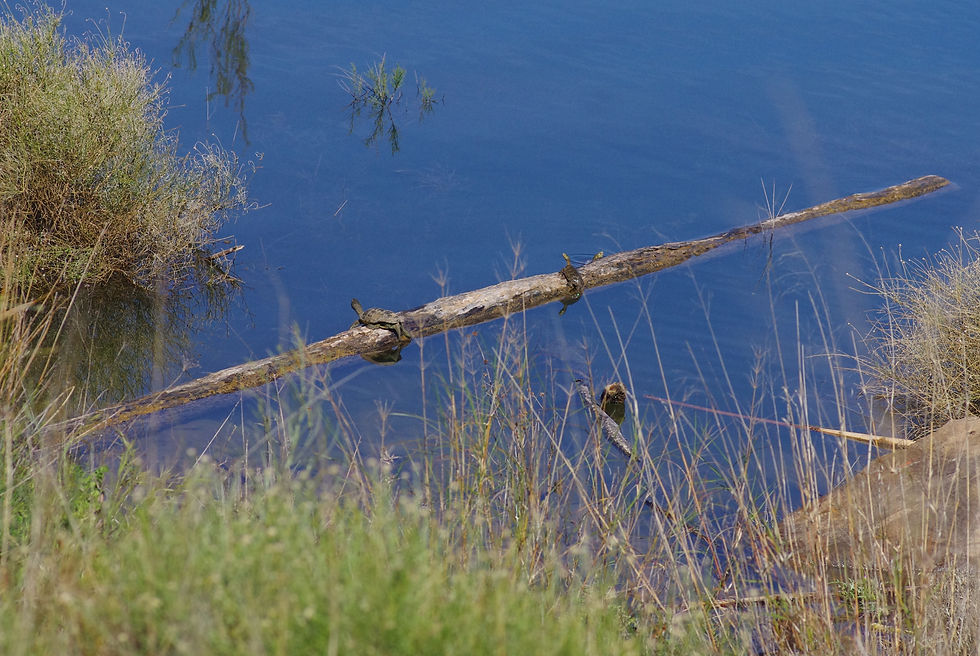
The first things we saw in the water were the numerous terrapins, Mauremys leprosa, basking on the floating logs and debris at the water’s edge. They were never on the land itself, and were incredibly wary, disappearing from their spot long before you were able to get close enough for a decent photo. The large individual in the above photo was apparently quite territorial and was behaving aggressively (or perhaps amorously..?) towards the smaller ones, inching up the log towards them and nodding his head vigorously whenever they hauled themselves out. The little ones didn't seem overly keen on this behaviour so shuffled away or plopped back in as he approached.

The plop of a terrapin disappearing was often confused by splashing from below, where groups of carp (Cyprinus carpio) were congregating around the shallow edge of the water and chasing one another; breeding season.
As I meandered around the shore, hampered by an unpleasant cold developed over the last day or so, I was called over to a patch of bare scrub where the ground had dried and hardened, colonised by tough grasses and little yellow leguminous plants. Tom had found one of my targets: Provence Hairstreak (Tomares ballus). I was blown away – I knew they were in southern Spain, but wasn’t sure where to find them or how to look for them.


Their appearance defies suitable description and my photo attempts certainly don't do them justice - they are surely one of Europe’s most beautiful butterflies, taking the most attractive qualities from Small Copper and Green Hairstreak and combining them into one compact parcel. There were multiple individuals, males and females (I believe I only photographed females) zig-zagging close to the ground and settling just out of reach, feeding nervously on the yellow vetch. They were flighty and took off if you made any significant movement, but when they landed it was very difficult to see them.


Under a rock: Myrmecophilus sp. crickets and Lucasius andalusicus, both inhabitants of ant nests.


In the meadows: Ectophasia sp. (a shield and squashbug parasite) and Camptopus lateralis

One final surprise as we made our way back was a silky-looking spider I noticed under a flat stone. She was medium-sized and brownish-grey, nothing incredibly noticeable about her pattern or markings, but something about her shape and feet looked evocative, and I got the vague feeling she was something special. I wasn’t thinking clearly, but if I had been I would have seen her for what she was immediately: a tarantula in miniature. In fact, this was western Europe’s only true tarantula species, Ischnocolus valentinus, family Theraphodisae. They really are small, not even half the size of a thumb, and at first glance quite inconspicuous in their hidden habitats. Other reports have said they can be quite difficult to photograph as they often retreat into their rough silk holes and stay there, so it was lucky that ours sat in the open for a little while.

Above: Ischnocolus valentinus
Sierra Nevada
Once again, we struck out towards the mountains of the Sierra Nevada, and once again we didn’t quite make it to the high spots. Instead, we found a pleasant-looking trail in a slightly lower area which consisted of a fairly easy uphill walk along vehicle tracks. At first, I was convinced that it would be a short up-and-done trail, but as we walked further this feeling was replaced with a gradual appreciation that this was a magical place. There was hardly any rubbish or dog poo, and very little evidence that this was a heavily used path. A truck hurtled past, scattering rocks and leaving a trail of white dust in his wake, and passed us again going back down nearly an hour later; aside from that, we saw no one.


Above: Cicindela campestris and Eurydema ventralis
Everywhere could be seen the droppings and footprints of Iberian Ibex (Capra pyrenaica); the area was obviously used frequently, and I wondered if we’d see one. We were in a steep-sided orange and white limestone valley with friable scree and rockfall on both sides, riddled with caves and holes and covered, where the terrain would permit, with stunted bushes and trees. It had a strange feeling to it, like the landscape was holding its breath, totally still.
Tom was rolling rocks when I caught up, and told me he found an ibex shelter under a tree with tracks, droppings and a 'mammalian smell'.
My sense of smell was starting to return after the congestion had lifted, but even with impaired senses there was little mistaking the briefest smell that the slight breeze sent my way as I stood up. I wondered briefly if I could be mistaken, but knew I wasn't. I clambered down the slope and stood under the tree as Tom climbed back onto the path, but still couldn't smell the 'goaty' smell he was describing. Once again, however, there was a short wave of sickly sweet; I followed it behind the tree and out into a dry stream bed dotted with small herbs and loose stones, on which my feet grated and slipped as I cautiously picked my way forward. I was now certain I knew what the smell was from, but it was still a shock when it appeared, completely invisible to the eye until you were practically on top of it.
It was a strange scene, peaceful and sad. The ibex lay amongst the soft deadnettle scrub in a small clearing, on his side, head propped slightly up by his horns, from which he could be identified as an adult male. He couldn't have been dead for more than a few days, and was already being attended by hundreds of flies of different sizes and colours, histerid beetles like black glass beads, and angular staphylinids prowling in the shadows of his flanks, raising their abdomens like little scorpions as they barged past the others. Even the odd butterfly settled briefly on his coat. He was magnificent, a goat on steroids; clad in coarse, tree-trunk brown fur which became longer and slightly lighter as it reached his belly, darker markings at his flanks and on his limbs, and his hooves perfectly cloven semi-circles at the end of short and stocky legs. His horns were incredible, steely grey-brown and shiny on top, as thick as my forearm, curving out and then inwards from a wide, thick head and muscular neck. I was surprised by how wild he actually looked compared to a typical goat. Certainly he was bigger, but he still retained a fierceness and respectability even in death.

It wasn't possible to stay very long in the vicinity - even Tom, who has a much less sensitive nose, was struggling. It was a shame, as there is no greater magnet for fascinating flies and beetles than carrion, and I was never guaranteed to observe an ibex this close up again in a natural setting. I paid my respects somewhat hurriedly and left. From the path that ran above, his body was hard to see unless you were really looking, and from below it was invisible until you were only a couple of feet away. For some time at least, he would be left in peace by any passers-by; there was a small chance he would remain that way forever. We decided to revisit at dusk, as it seemed like a very promising site and there was always the chance of seeing a live ibex or some evening reptiles.
We pulled in once again at the gravelled layby, but as we got out the conditions had changed – the sky was grey and the air humid, and a sharp, hot wind whipped leaves and twigs across the floor. The shade of the clouds brought out the intense colours of the stone and trees, while the breeze, now funnelled into a playful draft by the valley, kicked up clouds of the fine white road dust and made me cough and sneeze. It was coming from the other direction and into our faces, so if there were any mammals further up they wouldn’t be able to smell us.


Black Wheatears (Oenanthe leucura) chittered as they fluttered between the boulders, small dark phantoms glancing out of sight, flashing white warnings with their wings and tail. My parents had observed one catching butterflies and bringing them back to a nest inside the top of a small cave earlier in the day. A Blue Rock Thrush (Monticola solitarius) clad in royal indigo and navy alighted on the top of a cliff above, chucking quietly. The twitterings of unseen buntings and finches emanated from further away. We had been scanning a far-away ridge when I saw movement from the corner of my eye, much closer. I looked around but saw nothing, until it moved again – a female ibex.
What a joy to see one alive! She was swiftly joined by a friend, both of whom stared at us for several minutes from their vantage point, assessing how threatening we seemed to be. They didn’t need to have seen me lose my footing on the path earlier to know that there was no way we could be a threat to them here. Eventually, they relaxed a bit, and we watched them browsing amiably among the wispy bushes between the rocks.


These were the first of several living ibex we saw that evening. On the path they were fairly small, always in pairs and probably all young females. Some were more naïve than the two we first saw, and continued to graze as I walked past, unbothered. We later found that the roads were simply littered with them as we drove back down the mountain – they walked out in front of us, ran across the road and down over near-vertical cliffs and walls, or otherwise simply stared from the verges as we passed. It would have been amazing to walk the path as it got dark, but I'm somewhat glad we didn't in the end - I didn’t fancy avoiding the ibex in the dark on the balcony roads.
Málaga
On the way back to the airport we stopped at a site or two just west of Málaga. It seemed vaguely promising, a nondescript area of meadow and scrub with a small gravelled car park, where people walked their dogs. There were chameleon records nearby, but since the site wasn’t chosen in advance I knew and therefore expected nothing, which was funny because in true final-hour fashion, this was one of the best sites we visited. As soon as I exited the car I was tripping over viboreras laden with Psacasta tuberculata and exanthematica, a good sign that this was excellent habitat for bugs.


It was hot and quite humid, with lots of grasses, thistles and scrubby trees. The flowers were attracting a different cohort of insects, including a nice view of the fantastic and huge Xylocopa pubescens (above), a beautiful bee wearing shiny royal purples and blues, with rich golden fur on her thorax.


There were more species of meloid beetle at this site than I’d ever seen in one place before. The most obvious of these were the enormous females of Berberomeloe (above), either B. majalis or B. payoyo (consensus from iNaturalist seems to be the latter, although I don’t know the morphological differences) who were out digging their nest holes in the loose soil of the footpath. They are huge, one of Europe’s biggest beetles, and surprisingly nimble for such a cumbersome-looking creature. They were also quite vulnerable, absorbed in digging right in the middle of the paths, and I was relieved that the site was generally un-busy.

We found one fatality, which was sad, but in doing so also a fascinating scene with numerous tiny Anthicid beetles congregating around the dead one, feeding not on her body, but on her cantharidin, a toxin prized by other beetles. These small beetles will consume and accumulate the chemical, which protects them from their own predators. Other beetles are known to do this as well, especially Pyrochroidae (cardinal beetles), who will use both live and dead oil beetles and then use the chemical as a nuptial gift.


I found one individual of another oil beetle, Meloe tuccius (above), a species I’d seen in Malta the previous year. Their heavy punctuation on head, thorax and elytra can be seen from a distance, while their larger size separates from the superficially-similar M. rugosus, of which there are sporadic records in south Spain, and a few other rare species as well.


Abundant on the thistles was another species of blister beetle I didn’t recognise, nor had ever heard of before: Leptopalpus rostratus (above). They looked a bit like soldier beetles with their red colouration, but had a classic oil-beetle-shaped head. It was a very beetle-y morning.

Hoplia bilineata


Weevils – both Larinus?

Dandelion leaf beetle Exosoma lusitanicum

Onthophagus sp.

Tropinota squalida

Bugs-wise, it was fantastic to see a lovely Eurygaster hottentotta too, in addition to the E. austriaca that seem so common in this area. I had already seen this species on a previous trip, dead and out of season under a rock, so it was lovely to see a live one - albeit parasitised, with the dreaded (for a bug) tachinid egg stuck on.

Staria lunata


Spurgebug Dicranocephalus sp. and a squashbug, Coriomeris sp.

Haploprocta sulcicornis

Lovely little bee-flies
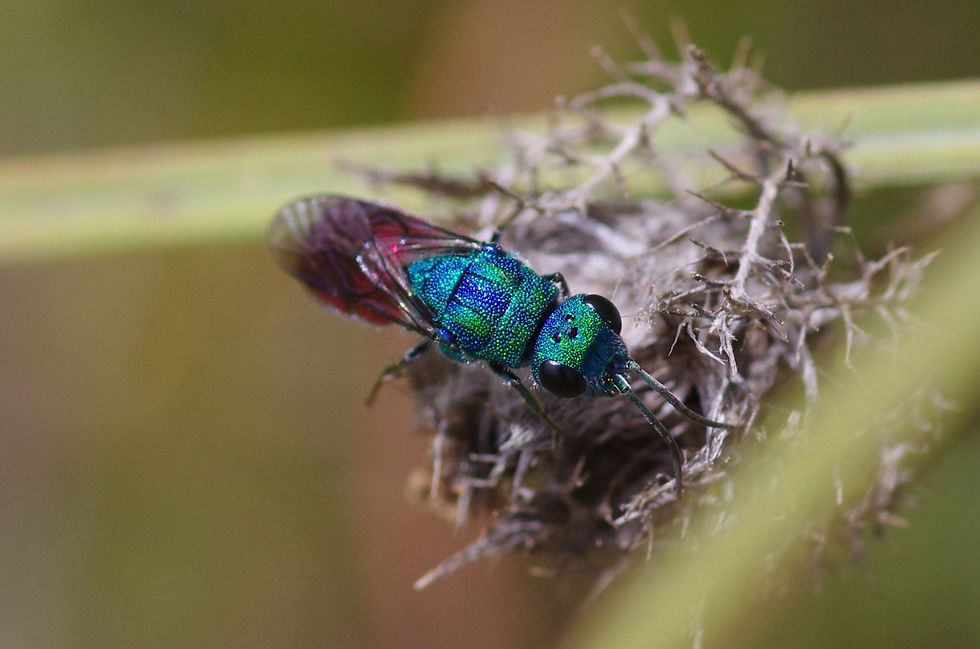
Chrysura sp. – quite a large one!
On the way back to the car, my parents finally found what they’d been searching for all week – a chameleon. She was beautiful and small, and exceptionally well-camouflaged. We lost her several times in the same tree without anybody having moved. When we approached and she realised we’d seen her, she puffed up and turned black with green flecks, a displeased colour scheme indeed. Once she had a minute to calm down, however, she mellowed out and went back to a pleasant shade of green. It took a lot of dedicated searching from my dad to find this one – we’d probably been walking past them all week, despite thinking we were putting in a good effort.


Common Chameleon (Chameleo chameleon)
Finally, under a sheet of heavy tile, I found what I had been searching for on and off – a snake that I got more than a moment’s view of. This was Macroprotodon brevis, the False Smooth Snake, a rather pretty-looking snake with shiny scales and somewhat googly orange eyes. He or she moved slowly, touching a passing beetle (Scaurus sp.) and a woodlouse (Porcellio ornatus) with her tongue, eventually slithering away into the bush after allowing us a minute or so to appreciate her appearance and behaviour.

A few others that didn't fit into the above categories:


Above: Lachnaia variolosa, Carthamus arborescens, Otala lactea, Parameles sp., Peucetia viridis and Chrysolina americana.

Above: Porcellio hoffmannseggii

Above: Zygaena lavandulae
Once again, observing and experiencing some of southern Spain's incredible biodiversity was a joyous and enriching experience. It was just as thrilling seeing the tiny Necrophylus crawling in its cave as it was watching ibex grazing and cliff-jumping. It may be a bit unimaginative to have a butterfly as a favourite of the trip, but really nothing beats those exquisite Provence Hairstreaks (and the Spanish Festoons, harlequins of the coast, aren't half bad either).
Invertebrate highlights
• Berberomeloe payoyo/majalis
• Berberomeloe insignis
• Hoplia bilineata
• Leptopalpus rostratus
• Necrophylus arenarius
• Xylocopa pubescens
Shieldbugs
• Brachynema germarii
• Canthophorus melanopterus
• Carpocoris mediterraneus
• Cydnus aterrimus
• Dolycoris baccarum
• Eurydema ornata
• Eurydema ventralis
• Eurygaster austriaca
• Eurygaster hottentotta
• Macroscytus brunneus
• Piezodorus lituratus
• Psacasta exanthematica
• Psacasta tuberculata
• Staria lunata
• Sciocoris sp.
Butterflies
• Anthocharis euphenoides (Provence Orange Tip)
• Colias croceus (Clouded Yellow)
• Glaucopsyche melanops (Black-eyed Blue / Pardilla)
• Papilio machaon (Swallowtail / Macaón)
• Pararge aegeria (Speckled Wood)
• Pieris rapae (Small White / Blanquita)
• Tomares ballus (Provence Hairstreak / Cardenillo)
• Vanessa cardui (Painted Lady / Vanesa de los cardos)
• Zerynthia rumina (Spanish Festoon)
Reptiles and Amphibians
• Chameleo chameleon (Common Chameleon / Camaleón Común)
• Hemidactylus turcicus (House Gecko / Salamanquesa rosada)
• Macroprotodon brevis (False Smooth Snake / Culebra de Cogulla)
• Mauremys leprosa (Mediterranean Turtle / Galápago leproso)
• Psammodromus algirus (Large Psammodromus / Lagartija Colilarga)
• Tarentola mauritanica (Moorish Gecko / Salamanquesa Común)
• Timon nevadensis (Sierra Nevada Ocellated Lizard / Lagarto bético)


